
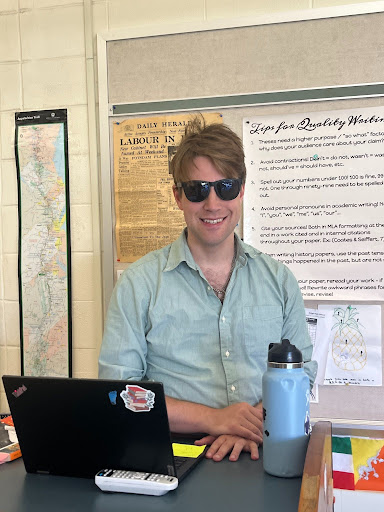
Mr. Coates has been a history teacher at Ridge High School since 2019. He grew up in Hightstown, New Jersey and spent some time in York, England and Obuasi, Ghana. Outside of work he can often be seen reading or spending time with friends and family. He thinks about the Roman Empire all day, every day.
KK: What inspired you to become a history teacher?
MC: After I graduated from college with a degree in History, I went to England and got a Masters Degree in History. After I came back from England, I had a bit of a crisis in the sense that I had this Masters in history but I asked myself, what should I do with my life? Then, I got a Masters in Education, so teaching is literally the only job I’m qualified to do. I have a Masters in History and Masters in Education, so I’m very qualified to do just teaching, but I’m very happy with my job.
KK: That’s very interesting. Is there a certain class in college that made you passionate about history?
MC: History was always my favorite subject, long before college. In my freshman year of high school, I took my school’s version of Honors Global, and even going back to elementary school I have always loved history. My dad and older brother were history majors, my grandfathers both fought in World War II, and my mother is a Christian minister, so we would always read the Bible as kids. The stories of history have always connected with me more than any other subject. I liked math and science when I was a kid (less so when I got older 😀,) but history was the only subject I really loved.
KK: It’s cool that you knew from such a young age that you wanted to pursue a career in history. Do you have a favorite era or historical event to teach about in your classes?
MC: That’s a really good question. I really like ancient history, which is funny because I never teach it. I don’t like it just because I think the characters are interesting, but I like it because so many of the foundations of the world we now live in, especially the idea of what it means to be a Westerner, come to us directly from the Greeks and Romans. The ideas of democracy, individual rights, concepts of good and evil and redemption, are culturally contingent (not universal, different between cultures) based on developments from a few thousand years ago. I also really like studying Chinese history because it proves that the way Westerners see themselves is culturally contingent because Chinese development has been radically different. I also really like the last 40 years of history, because it will tell you so much about the world we live in right now.
KK: Whenever I took history, I always enjoyed learning about WWII, especially because of my Polish background. When I was taking Honors Global freshman year, I also loved the unit about the Six Wives of Henry the 8th – it was really fun!
MC: It’s like a soap opera. But WWII is sort of the modern foundation myth. Not myth in the sense that it didn’t happen, it did happen, but myth in the sense that it is the story we tell ourselves about who we are – much of it comes from the Second World War. We were the good guys, they were the bad guys. We saved the world, I mean it really sort of justifies a lot of the stuff that comes after.
KK: And also it teaches us to not let history repeat itself. I know you were saying a lot of the foundations of the world we live in come from ancient history. History is a subject in which you have to critically think, but now in this era of AI, what are your thoughts about the rise of AI and how it should be used in the classroom and workplace, especially in terms of history?
MC: If it was up to me, AI wouldn’t be used in either the workplace or classroom:) While I can prevent it from being used in the classroom, it is being used in the workplace. AI is the biggest fundamental shift in thinking since the Protestant reformation. Before the Protestant reformation, the Catholic Church had monopoly on knowledge. Eventually, Martin Luther (a German priest and theologian) said, “I’m a person who can read the Bible, I can come to my own conclusions, and we all can.” Martin Luther’s words began the Protestant reformation and decentralized the idea of knowledge – you can argue that this was a positive or a negative or whatever but it didn’t fundamentally destroy people’s ability to come to terms with what they accept as the truth. The rise of AI is a lot more worrying, because learning is a struggle. We learn a lot more by getting things wrong than right, that is the fundamental building block of learning, and through AI, people will go for quick, easy answers rather than going through the struggle. Something I was thinking about a lot lately is your generation, and how I would feel if I was your age right now. If I was your age, I think I’d be tempted to use AI a lot but I think I’d also be pretty angry that my generation would not have as much capacity for original, critical thought.
KK: Especially at the end of the year, a lot of seniors are thinking, I already took my AP exams, my grades don’t matter anymore. That’s pretty sad, because people don’t show their passion for learning anymore.
MC: Yeah, if freedom means doing what we want, then what do we want? I think we have to want something other than more pleasure. There has to be some sort of higher purpose than convenience and gratification. Ultimately, then you start wondering what the whole purpose of being alive is if a machine can do the things that humans have traditionally done. Just like the protestant reformation forced people to re-examine those questions on a deeply, fundamental level that ultimately resulted in the deaths of millions of people, I have similar concerns about the rise of AI.
KK: What is something that you hope students will take away from your class?
MC: Oh, boy. My enduring understandings, as we call them. I was talking about this yesterday with Mrs. Seiffert and Mrs. Stederonski. In my genocide class, when I rewrote the curriculum, I wrote that the two enduring understandings of the genocide course are: 1. I want the students to understand why and how genocides happen and 2. (which is more important to me), I want students to understand that they have a responsibility to care about other people. I was reading an essay a student wrote about the importance of reading fiction, because when you read fiction you develop a capacity for empathy, and it broke my heart for a moment to think, do kids need to be told why empathy is important? Do we not just automatically understand why? The answer is that people don’t automatically understand why empathy is important. We care more about materialism, ourselves, money, what we want. So I care about historical facts and I want people to understand history, but I think the most important thing I can try to do through teaching history is to build and generate a capacity for empathy within my students.
KK: I know you like to read a lot and listen to podcasts – do you have any book or podcast recommendations for high school students?
MC: I keep my own little library in my classroom for students, and I have books constantly circulating through, which is nice. I started doing this a few months ago. I listen to a podcast all the time called The Rest is History. Some of my AP Euro students told me that they’ve listened to it, either on their own or because of my reccomendation. Despite the fact that I only found it a few years ago, I have really taken inspiration from it because although I teach genocide, I don’t think history should just be miserable and depressing, I think it’s ok to actually have fun with this stuff. Fun is pretty important to me and I don’t want my classes to be miserable. When you were in my Honors Global class, your class kept the quotebook, where you wrote down the ridiculous things I said throughout the year. But I actually think those ridiculous things are kind of important, right, because the options when looking at these tremendously miserable things throughout history are to either cry and get crushed by the overwhelming emotional weight of it all, or to use humor, which is a perfectly valid defense mechanism that allows you to operate within everything and continue engaging with it. If you want to engage with history, a sense of humor is necessary.
KK: Exactly. I’ve always enjoyed listening to soundtracks of broadway musicals, and I remember when we were doing the unit on Henry the 8th I would listen to the Six soundtrack , which definitely brought a sense of fun to history. Speaking of which, what type of music do you like to listen to?
MC: Mr. Gebhardt referred to his taste in music as Catholic which I thought was a funny way of describing it. Catholic comes from the Greek word Catholicos which means universal, so what he meant by that is that he likes to be open to all genres of music. I try to be that way as well, although I may be a little bigoted. I do like classical music, I also like punk rock, bands like the Dead Kennedys or Black Flag. I put them on now and I don’t enjoy them as much as I used to, they were more important to me when I was younger. I wrote my college essay on a band called Crass, which in AP Euro I had two kids present on. When we put it on, I had to tell the audience it’s not supposed to be sonically appealing. I really like the Beatles, Rolling Stones, Beach Boys – stuff my parents listen to. Classical music – Shostakovich, Rachmaninoff (#2 and 3), and Mahler (Mahler 5 is my favorite). I have a deep love of classical music, but I am sad to say I can’t play anything. I like Irish Folk Music, my favorite band is an alternative rock band called They Might be Giants. I try to have a pretty broad music taste. To your point, I listen to more audiobooks and podcasts than I listen to music. But now that I have kids, I have a three year old and I’ll have a daughter in July, I’ve brought music back into my life a lot more. I can’t stand most kids’ music, like Baby Shark. My three year old likes Black Sabbath and The Beatles because I put it on – he’ll be asking for Yellow Submarine.
KK: Sounds like your kid already has great music taste! To conclude the interview, do you have any advice for yourself as a high schooler, or high school students in general?
MC: Calm down. It’s all going to be ok. It’s easy for me to say because I’m 36 and I have seen that it has all been ok, whereas I can’t promise you that all of your lives will be ok, although I do have a strong suspicion that almost all of your lives will be just fine. All the things I thought were important, like girls and music and stuff, all of that stuff will sort itself out. Also say yes to things, take advantage of opportunities, be aware that fewer will open up when you are older, since you will have obligations and responsibilities, don’t be afraid of getting older, there’s a lot of great things that come with age. Mainly just calm down, try to enjoy things.
KK: Thank you so much for your time, Mr. Coates! This was a great interview!
MC: Thank you, Klaudia!