
Write faster, you only have 50 minutes
Skip this, it’s not on the test
Don’t worry, I’ll just trace off a picture
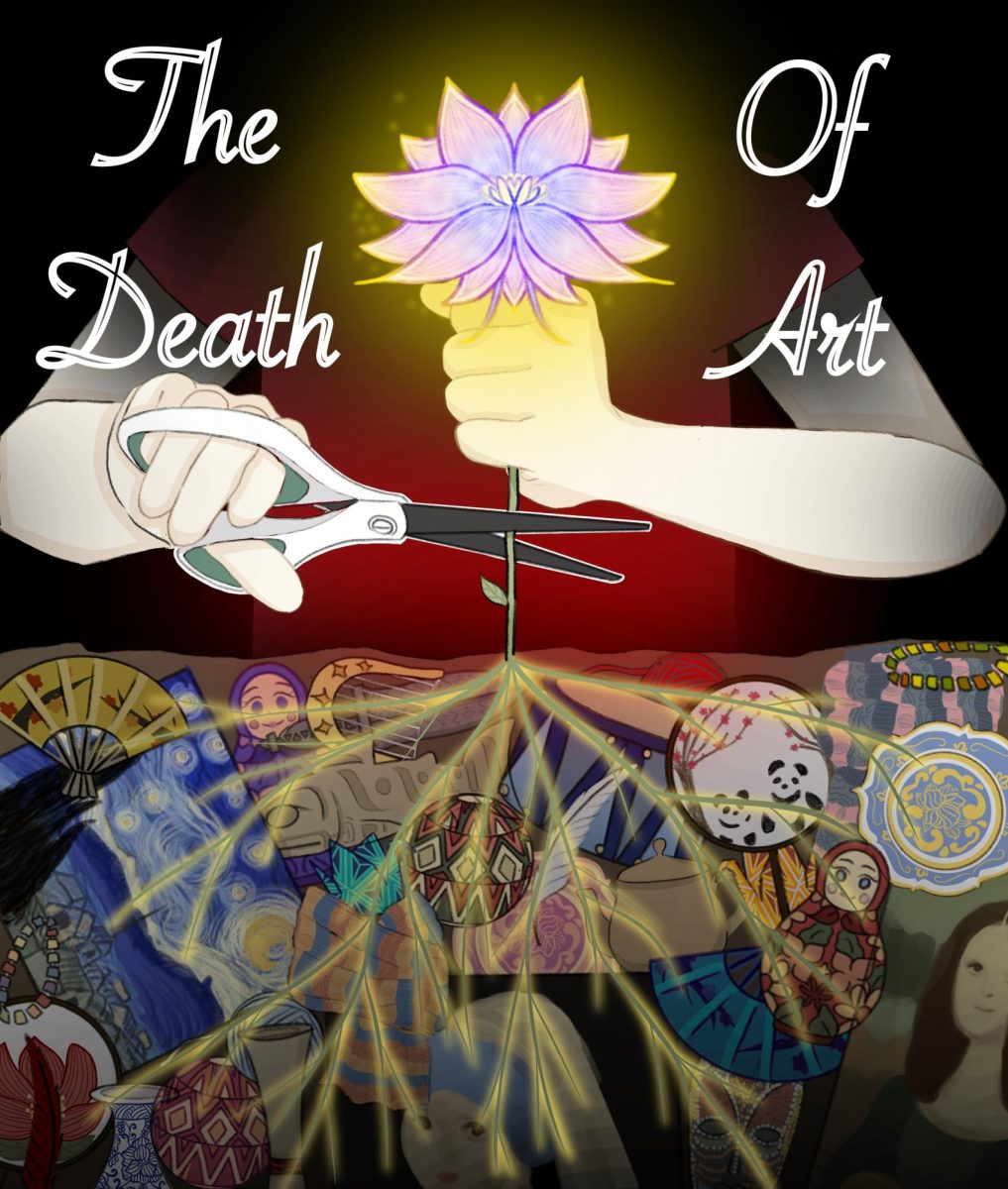
Since an undefined and unknown start, we have been on an endless chase for speed, for efficiency, sacrificing dignity and quality. Art, an unique expression of society, began to be lost. So, when did art’s importance become diminished?
Maybe it was the rise of civilization.
When joining individuals into a larger group, we inevitably forced people to abandon their unique interest for the benefit of the majority. Utilitarianism, we said. The greatest good for the greatest number of people meant giving up on the minor talents. People’s values were determined by how many deer they hunted in the day, not the interest of stories by the night bonfire. Tales, as valuable as they were, were not so important in the face of life and death. So when the warriors got titles and musicians got nothing, the value part of art died.
But myths and cave art are preserved. So maybe it was colonization.
When the men of paler skin set foot onto rough foreign soil, they found the traditions of the local tribes barbaric. Dances, rituals, traditions, were out of date. They weren’t culture, no, they were a sign of backwardness. The blood red from minerals extracted by the enslaved were simply brighter than the paint gathered from nature. The indigenous people didn’t focus on the right things, didn’t believe in the right God, didn’t speak the right language. They needed to be educated. So as the European schools and Evangelical Churches sprung off the ground once used for ceremonies, the diverse part of art died.
But the colonizers had artists, architects, and poets too. So maybe it was the Industrial Revolution.
When the metal machine began huffing and puffing and blew all the handicraftsmen away, people turned towards mass production. Workers in assembly lines did not need thoughts or opinions; they were merely a tool, a replaceable gear of a larger monster that produced endlessly. No more was artisanship, no more was apprenticeship. The lower class going back home—shoeboxes crammed with disease and poverty—did not have the energy to illustrate designs. So as the intricate architecture turned into monochrome concrete buildings, the creative part of art died.
But people still had art inside of them. So maybe it was standardized education.
School, at the end of the day, is a one size fits all system. Success is determined by a test score, a leadership position, a letter grade, a university ranking, an acceptance letter. Children dreaming of becoming artists, poets, singers, dancers, authors, listened to their parents and became lawyers, doctors, technicians, engineers, managers. What’s on the syllabus is what is in a student’s mind; nothing more, nothing less. Each student follows a precise schedule, hurrying from one place to the next, erasing their expressions to fit the perfect model. So as young children were taught that their dreams were unachievable, the imaginative part of art died.
But we still have small businesses and art schools. So maybe it was social media.
Fast fashion, trends, hashtags, likes, comments, shares, views, revenge bed time procrastination, doomscroll, shorts, all cut our attention into little pieces. The dopamine rush from looking at fragmented information erased the ability to sit down and do things slowly. Short summaries of books were enough to understand the work as a whole. Newspapers were too long, reporters talked too slow. Nowadays, nobody has time to waste, time to chew up every word of a novel, time to spend on boring work. So as paper collected dust in the corner of the dark room lit by the phone, the patience part of art died.
But books and drawings still exist online. So maybe it is AI.
Oh, how the Google AI Overview is loved, even though its direct information often misinterpreted sources. ChatGPT is everyone’s best friend, while it creates an echo chamber of thoughts and opinions. Writers are obsolete, DeepAI could generate anything. Artists are no longer needed, a simple request on Adobe returns a vivid image within seconds. The usage of AI is constantly being normalized by society itself, like schools requesting teachers to incorporate AI instead of standing against it. Nobody thinks AI is stoppable, everybody believes it’s an inevitable future. So as people dropped their pencils and typed to codes, the future part of art died.
So when did art die?
Art died when we stopped thinking, stopped caring.
Art died when no more thought was given into our actions as we mindlessly followed orders.
Art died when the shortcut was not only appealing, but the common answer.
Can you tell if this was written by ChatGPT or a real human? You probably can, right? Since it sounds so human. But as every second on the clock ticks, a new essay is fed into AI. Every hour, the algorithm learns something else. Every day, the code becomes more human. Just in a year, we went from laughing at Will Smith eating spaghetti to failing to discern deepfakes. A century ago, we made children’s futures decided upon by mere numbers. 300 years ago, we forgot the concept of patience and devotion. 600 years ago, we normalized suppressing cultures and genociding ethnic groups. Out of over 100 thousand years of human history building up art, it only took 3% of the total time to destroy it.
In the near future, we will be unable to tell AI apart from the rest of us. They’ll take our appearance, our voice, our every expression. It is then, when humans lose even the concept of art, that art truly dies.